
The Serpent Was Not a Snake
From Eden to Revelation: One Rebel, One Fall
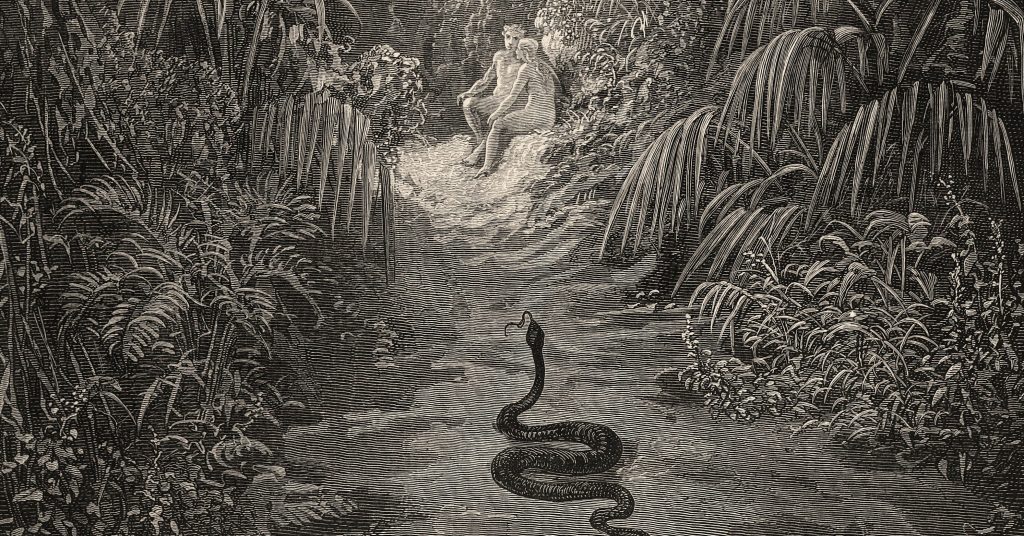
For centuries, illuminated manuscripts and Sunday school flannel boards have given us the same image when discussing the nachash — the serpent of Genesis chapter 3: a literal serpent dangling from a tree branch flicking its tongue at Eve. Perhaps Satan animated this talking snake the same way a hand animates a puppet; perhaps this was actually the physical form of the ancient enemy.
It’s a tidy picture.
It is also almost certainly wrong.
Untangling why opens up one of the most theologically loaded threads in the entire Bible — one that runs from the nachash in Genesis 3 to a dragon in Revelation 12, with several detours through the corpses of ancient kings along the way.
Let’s start with the word.
The Nachash of Genesis 3: Shining One, Not Garden Snake
The Hebrew word in Genesis 3 is nachash. Yes, it can mean “snake” — that’s its most common usage elsewhere in the Old Testament. However, the root nachash carries a second, older semantic range. The very same root connects directly to descriptions of shining, to bronze, and to divination. The “shining one” and “the diviner” are both legitimate readings of the same consonants, and Genesis 3 gives us a figure that fits the shining diviner far better than it fits a talking reptile.
This nachash speaks.
The author of Genesis describes the serpent reasoning and making a theological argument sophisticated enough to out-wit the woman. No animal in Scripture does this. What we’re looking at in Eden is not a snake that got unusually clever — it’s a being with a name that meant something closer to “the shining seducer” appearing to two newly created humans in a posture of false counsel.
That single word-study move already dismantles the medieval image. But it’s only the doorway. Once you stop reading nachash as “snake,” you’re free to ask a much bigger question: where else does Scripture talk about this kind of figure, and does it ever name him directly?
It does. Three times, in fact — and each time, it adds a piece the others don’t have.
Ezekiel 28: The Cherub Who Defiled Eden
Ezekiel 28 is ostensibly an oracle against the king of Tyre. But partway through, the language breaks the frame entirely. Ezekiel then describes the king as being “in Eden, the garden of God,” and “the anointed cherub,” perfect “from the day you were created, till iniquity was found in you.” Almighty God cast him down from the mountain of God for the sin of pride — wanting to be worshipped, wanting to ascend.
No human king was ever in Eden (except for Adam), and no human king is called a cherub. The text is doing what apocalyptic and prophetic literature often does — using a human ruler as a kind of screen, projecting a deeper cosmic reality onto him. The king of Tyre becomes the occasion; the actual subject is the being who was present at Eden’s founding and was cast down from it for the sin of self-exaltation.
But Isn’t He Called a Cherub?
This is also where the strongest objection to identifying this figure with the Genesis 3 nachash — the serpent of Eden — comes in. This objection deserves a direct answer, not a dismissal. Ezekiel 28 calls this being a cherub — but Scripture never calls the Genesis 3 nachash a cherub. If anything, the shining/serpentine language places him closer to seraph territory (the root saraph, “burning one,” shares the same fiery, luminous semantic field as nachash’s “shining”). Cherubim and seraphim are not interchangeable categories in the text.
Cherubim guard the throne. YHWH places a Cherubim at Eden’s gate after the fall specifically to keep humanity out. Seraphim burn, hover, and proclaim holiness in Isaiah 6. If Scripture is careful enough to distinguish these classes elsewhere, the argument goes, it’s special pleading to flatten them into the same being here.
Function Does Not Equal Species
It’s a fair point, and I don’t think the answer is to deny the distinction — it’s to recognize what kind of distinction it is. Cherubim, Seraphim, and nachash aren’t being used as taxonomic labels the way a zoologist sorts species. They’re functional and visual epithets, describing what a being does or how a being appears in a given scene, not what genus it permanently belongs to. Ezekiel 28 itself shows this fluidity in miniature: the same figure is “the anointed cherub who covers” — a guardian title, describing his original office — and then, two verses later, a being whose “heart was lifted up because of your beauty” and who is “cast… to the ground.”
The cherub-language describes his post in Eden before the fall. It doesn’t lock him into a fixed species-category for the rest of canonical history. A being can be described as a guardian cherub in his office and as a shining seducer in his transgression without the text being careless. The same way a single man can be described as a soldier in one sentence and a traitor in the next.
So, Ezekiel 28 gives us the place (Eden), the original office (guardian), and the sin (pride, the desire to be worshipped as divine). Isaiah 14 gives us the ambition stated explicitly.
Isaiah 14: “I Will Ascend”
Like Ezekiel 28, Isaiah 14 is framed as an oracle against a human king — this time Babylon’s. And like Ezekiel 28, it breaks its human frame almost immediately. This king is “Day Star, son of Dawn” — helel ben-shachar in Hebrew, rendered “Lucifer” in the Latin Vulgate and ever since in English tradition. He said in his heart: I will ascend to heaven; I will raise my throne above the stars of God… I will make myself like the Most High. And he is “brought down to Sheol, to the depths of the pit.”
Ezekiel 28 shows the same type — exaltation, the desire to ascend and be worshipped, judgment, descent to the realm of the dead — but Isaiah adds the explicit ambition in the figure’s own words. We now have a being who was beautiful, who held high office, who wanted godhood, and who fell. What we don’t yet have is confirmation that he didn’t fall alone.
Now, if we head back to Ezekiel and read forward a few chapters, we find a subtle and enigmatic passage that changes everything — and almost nobody uses it. Ezekiel 31 is the hinge the whole argument turns on.
Continue reading the full article on Substack.
Subscribe free and Chapter 1 of The Ancient Wars: From Cain to Caesar lands straight in your inbox.
