
The Cosmic Mountain Unveiled
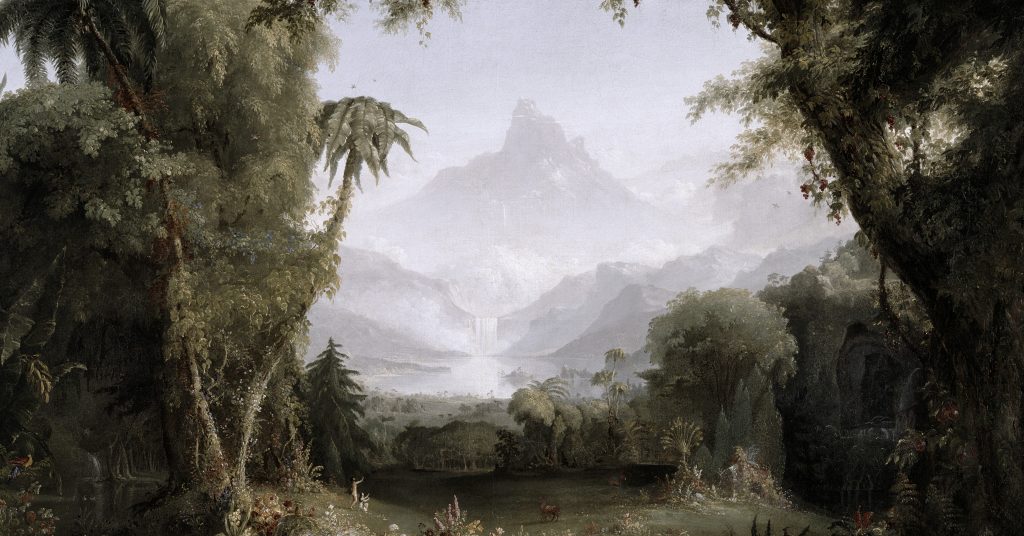
Eden Was a Mountain — And That Changes Everything
Most of us were handed a picture of Eden that looks something like this: a lush, flat garden somewhere in the ancient Near East, two people, a tree, a snake, and a catastrophic mistake.
That picture isn’t wrong exactly. But it’s incomplete in ways that matter enormously.
Because Eden wasn’t just a garden.
It was a mountain that functioned as a temple. The primordial place where heaven and earth were joined — the axis around which all of creation turned. And the moment you see it that way, everything that follows in Scripture snaps into a focus you can’t unsee.
Clues in the Geography
Genesis 2 contains a detail so easy to skip over that most readers never pause on it. After describing the garden, the text tells us about its water source:
“A river flowed out of Eden to water the garden, and there it divided and became four rivers.”
One river flows out of Eden and then divides into four — the Pishon, the Gihon, the Tigris, and the Euphrates.
Here’s the thing about rivers: they don’t originate in lowlands. Water descends. Rivers flow from elevated sources. The geography of Genesis 2 quietly but unmistakably assumes height. There, we can perceive that Eden was not a sea-level oasis, it was an elevated source from which life flowed outward to the earth.
This isn’t a modern interpretive trick. Ezekiel sees it — his vision of the river flowing from the temple (Ezek. 47:1–12) echoes the same pattern. John sees it in Revelation — the river of life issuing from the throne of God (Rev. 22:1–3). And in perhaps the most explicit statement in all of Scripture, Ezekiel identifies Eden directly: “the holy mountain of God” (Ezek. 28:13–14).
Eden was a mountain. Scripture says so.
The Original Temple
In the language of ancient cosmology, Eden functioned as what scholars call the axis mundi — the central axis linking the heavenly realm with the earthly. It was the place where God and humanity met and the point where heaven touched earth.
In other words: a temple.
The original temple.
The first earthly dwelling place of the Creator.
This becomes even clearer when you look at the language used to describe Adam’s role there. Genesis 2:15 says YHWH placed Adam in the garden “to work it and keep it.” In Hebrew, those verbs are ʿābad and shāmar. And here’s what most English readers miss — when those two verbs appear together elsewhere in the Old Testament, they describe the Levites’ guardianship of the sanctuary (Num. 3:7–8; 8:25–26; 18:5–6).
Adam wasn’t just a gardener. He was a priest-king, tending sacred space, guarding its holiness, and mediating divine presence to the creation under his care. Eden was his sanctuary. And YHWH Himself walked there — in visible, embodied form — in the cool of the day (Gen. 3:8).
This is the original pattern: God descending to dwell with His image-bearers in sacred space on an elevated holy mountain. That pattern will echo across the entire biblical narrative.
Sinai. Zion. The temple mount. The New Jerusalem descending from heaven in Revelation 21.
Every one of them is Eden’s echo.
Continue reading the full article on Substack.
Subscribe free and Chapter 1 of The Ancient Wars: From Cain to Caesar lands straight in your inbox.
