The Dragon Takes a Name
Greece and the Abomination of Desolation Reveal How Zeus Became the Face of the Cosmic Rebellion
A God With Too Many Names
For most of the Old Testament, the cosmic conflict is not represented by just one name.
It has many.
Baal rules the storm from Canaan. Molech demands children in the valley of Hinnom. Chemosh sits enthroned in Moab. Milcom holds Ammon. Each of these nations had its own pantheon of gods, its own sacred mountains, and its own blood-soaked altars. All were evidence of a fractured inheritance going all the way back to Babel, where the Most High “divided mankind” and “fixed the borders of the peoples according to the number of the sons of God” (Deut. 32:8). Israel alone was set apart as YHWH’s own (Deut. 32:9).
However, when Alexander the Great crossed the Hellespont, something changed.
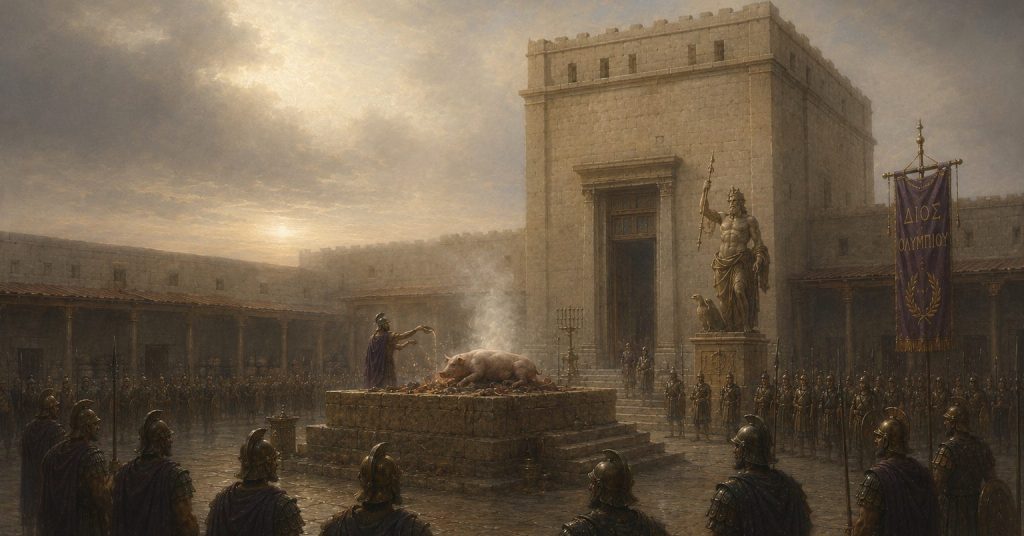
By 167 BC, a Seleucid king named Antiochus IV stood in Jerusalem and ordered a pig sacrificed on YHWH’s altar. The many gods of the nations were quietly being sorted into a unified family tree — and one figure sat at the top of it. More on that later.
When we treat the Abomination of Desolation account as just a cruel king desecrating a temple or some distant eschatological event, we miss the real story. During those transitional years of Hellenism, the profaning of Zerubbabel’s temple was the moment the adversary stopped hiding behind a scattered pantheon and reached for a single throne.
You said in your heart,
‘I will ascend to heaven; above the stars of God I will set my throne on high; I will sit on the mount of assembly in the far reaches of the north; I will ascend above the heights of the clouds; I will make myself like the Most High.’
But you are brought down to Sheol, to the far reaches of the pit.
A Cosmic Family Tree
The syncretism of the Hellenistic world wasn’t a simple merging of every foreign god into one. Greek mythology already had its own internal hierarchy, and as Hellenism moved east with Alexander’s armies, the local gods of the conquered peoples got sorted into that hierarchy — some as Zeus’s peers or offspring, others were folded into the older, deposed generation that Zeus himself had overthrown.
That cluster of older, darker cults got absorbed one into Kronos — the Titan king Zeus dethroned to become ruler of Olympus. El, the old high god of the Canaanite divine council, was merged with Kronos. Milcom of Ammon and Chemosh of Moab were drawn into that same Kronos-Titan orbit. Even Molech, the horror of Leviticus 18 and 20, the god who demanded infants pass through fire, was identified by Greek and Phoenician writers with Kronos.
However, probably the most famous of the Old Testament pagan gods, Baal, was not matched with Kronos. Baal was the closest match to Zeus. Baal was the “storm-lord” and “rider of the clouds” and he reigned on Mount Zaphon. Zeus was also identified as the “storm-lord”, and He reigned from Mount Olympus. Both Baal and Zeus were functionally overlapping storm-and-kingship deities, which is part of why the identification stuck so easily.
The Greek myth itself already told the story of one god deposing an older, monstrous generation to sit alone at the summit — Zeus overthrowing Kronos and the Titans to become king of the gods. When the fractured, often horrifying regional cults of the ancient Near East were absorbed into that story, they were placed into a hierarchy that already ended in a single throne. The moniker of Kronos absorbed the darker, older gods being subordinated while Zeus absorbed the position of supreme ruler standing over all of it. The ancient world’s fractured pantheon was being reorganized, rung by rung, underneath one consolidating divine kingship.
This reorganization was built around a simple idea: your god and our god always belonged to the same family, and here is exactly where yours fits. It was Babel’s fragmentation quietly running in reverse. The nations were not being reconciled to YHWH, rather the powers behind the nations were being reorganized under a different, unholy throne.
For hundreds of years the cosmic rebellion had operated as a loose confederation of regional powers. Now, as Greek language, Greek philosophy, and Greek myth spread from Egypt to the Indus, it began to look like something closer to a single throne with many provinces.
Continue reading the full article on Substack.
Subscribe free and Chapter 1 of The Ancient Wars: From Cain to Caesar lands straight in your inbox.