Babel and the Gods of the Nations
How one judgment at a tower in Shinar remapped the spiritual geography of the entire earth
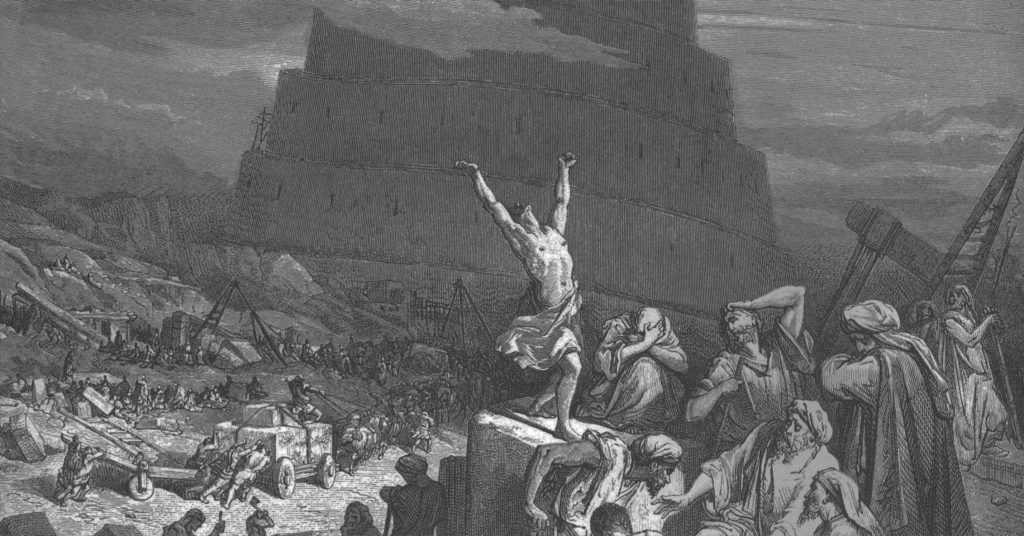
Most people know the story of Babel as a Sunday-school footnote: humanity got prideful, built a tower, God confused their languages, everybody scattered. Roll credits.
But read the text closely, and Babel stops looking like a footnote — especially once you read it alongside Deuteronomy 32 and Psalm 82. In full context, the familiar episode takes on a whole new persona. It becomes the hinge point of the entire Old Testament. We usually picture it as a caricature of confused men and nothing more. But it was actually the moment YHWH judicially divided the nations of the earth and handed them over to members of His own divine council — who then rebelled against Him too.
This is the story of the gods of the nations. They started as emissaries but turned into unfaithful rebels.
A Tower With a Purpose
Genesis 11 doesn’t describe a random construction project:
“Come, let us build ourselves a city and a tower with its top in the heavens, and let us make a name for ourselves, lest we be dispersed over the face of the whole earth.”
The tower — migdāl — was almost certainly a ziggurat, the ancient Near Eastern stepped structure built as a “world-mountain.” It was a man-made staircase to the heavens. Babylon’s later Etemenanki, the “House of the Foundation of Heaven and Earth,” is the classic example: a seven-tiered tower topped with a shrine. Ancient people believed the gods descended there to meet with men.
The Counterfeit
In Eden, YHWH walked down to dwell with man in a garden on a mountain. At Babel, man built his own mountain and tried to climb up to become like the gods. It’s Eden inverted — technology and brick in place of divine grace, ascent instead of descent.

Nimrod’s ambition at Babel wasn’t the first time humanity tried this. Back in Genesis 4, Cain built the first city on earth and named it after himself — not after God. Babel is that same impulse, scaled up to an empire. Humanity tried to shed the imago Dei — its identity as image-bearers — and make a name for itself instead.
“Let Us Go Down”
YHWH’s response is where things get interesting:
“Come, let us go down and there confuse their language, so that they may not understand one another’s speech.”
That’s not the first “us” in the Torah. Genesis 1:26 uses the exact same language — “Let us make man in our image.” Who is YHWH talking to?
Two Views, One Council
History gives two major answers:
The Trinitarian view — YHWH speaking within the Godhead: Father, Son, and Spirit.
The Divine Council view — YHWH addressing the heavenly host that surrounds His throne, the “sons of God” who appear throughout the Old Testament (cf. Job 1:6; Ps. 89:5–7).
These two views aren’t actually mutually exclusive. But grammatically and contextually, the Divine Council reading fits best — and it’s not new or fringe. It’s all over the Hebrew Bible, once you know to look for it. (Members of that council have zero creative power, by the way — that belongs to YHWH alone. This isn’t polytheism; it’s a royal court.)
Why does this matter for Babel? Because what happens next only makes sense once you see the council in the room.
The Verse That Rewires Everything
Here’s the text almost nobody preaches on. It’s the real engine behind this whole essay:
“When the Most High gave to the nations their inheritance, when he divided mankind, he fixed the borders of the peoples according to the number of the sons of God. But the LORD’s portion is his people, Jacob his allotted heritage.”
Read that again slowly.
The oldest and most reliable manuscript traditions — the Dead Sea Scrolls and the Septuagint — preserve “sons of God,” bene ha-elohim, in verse 8. Later scribal traditions smoothed this to “sons of Israel.” We can’t know for certain why the variant occurred. But one likely reason: a room full of divine beings receiving nations as an inheritance made later copyists nervous. The earlier reading is almost certainly original, and it changes everything.
The Allotment
Here’s what it’s saying: when YHWH scattered the seventy nations of Genesis 10 at Babel, He didn’t leave them ungoverned. He handed the nations over to members of His own divine council to rule and steward. YHWH called Abram, and later Israel, out of these nations as His direct portion — no intermediary, no delegated authority. Just YHWH and His people.
“When the Most High gave to the nations their inheritance, when he divided mankind, he fixed the borders of the peoples according to the number of the sons of God. But the LORD’s portion is his people, Jacob his allotted heritage.”
That’s the moment humanity stopped being one family under YHWH and became many nations under many “gods.”
Continue reading the full article on Substack.
Subscribe free and Chapter 1 of The Ancient Wars: From Cain to Caesar lands straight in your inbox.